Think back to the hottest pepper you’ve ever eaten. Recall how immediately your every fiber recoiled with that first bite. The way the incendiary sensation tore across the nerve endings of your mouth, inflaming you with agony that no amount of water could douse.
What you were feeling is capsaicin, a nasty little compound produced by peppers that your body thinks is poison. Since it assumes (sometimes rightfully so) that it’s being attacked, your body responds by lighting up pain receptors pretty much all over your body, inside and out. It’s something only the foolhardy push too far.
The amount of agony a pepper will leave you in is measured in scoville units. Depending on your tolerance, that hottest pepper you ever ate was probably a habanero, which runs from 100,000-350,000 scoville units. For comparison, Tabasco sauce runs 7,000-8,000.
Maybe if you’re adventurous, it was the legendary ghost pepper, which can run as high as a million. Pretty hot, right? That’s right about the same scoville range, for perspective, as pepper spray. Which, you might note, is not a foodstuff. It’s a weapon.
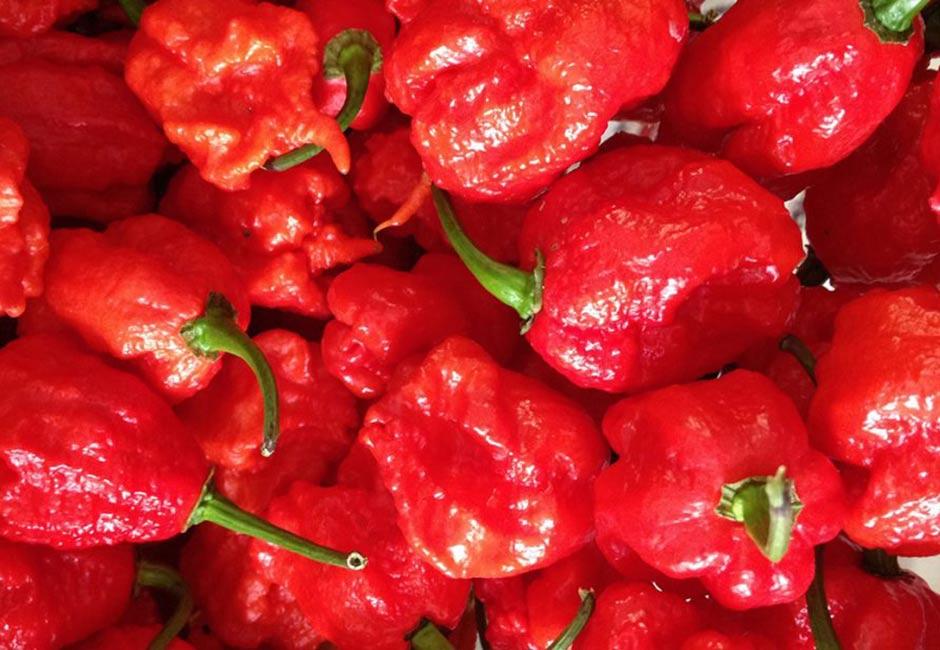
Now, take that same level of gastronomical torture and increase it by half. What you’ll wind up with is a 1.569 million scoville-rated gut punch of a pepper that goes by the name of the Carolina Reaper. Far beyond spicy, the Reaper is in a class by itself of peppers that tread the line between gastronomy and punishment. Which is why it’s so crazy that its inventor, “Smokin’” Ed Currie, is so cavalier about eating them.
“I eat them every day. I eat stuff made from them every day,” he said, before conceding. “Most people would not consider putting this in their mouth.”
But Ed Currie is not most people. The owner and chief mad scientist of the Puckerbutt Pepper Company in Fort Mill, S.C., Currie has long been fascinated by plants, a life-long devotion nurtured by his mother, a master gardener. Although he’s always had a green thumb, Currie actually started out in the financial industry. He still kept up his gardening, but it was of a… distinctly covert nature, and one that is not legal in most states.
“I got really into growing pot in the ’70s and ’80s,” he said candidly. Don’t worry, he just sticks to peppers these days, especially since his research into these tiny yet painful wonders proved that they may just be the cure-all for mankind.
“People around the equator have little to no cancer and heart disease,” he said. “They smoke, they drink, they do all the things they tell us not to do here. I could standardize everything they had in common and one of them was chilies.”
In fact, Puckerbutt isn’t just devoted to scorching taste buds. Currie devotes a slew of resources to researching health benefits of peppers, from cancer prevention to fighting childhood obesity. A powdered blend of chilies Currie created was found to increase metabolism and block fat absorption in overweight children, a key to helping end the epidemic.
And while his devotion to the pepper as science is laudable, it’s his devotion to creating the most powerful peppers in existence that earned him the nickname Smokin’ Ed.
Thanks to his reputation in the pepper community, Currie receives unique and exotic peppers from all over the world. Like a botanical Frankenstein, he started experimenting about 15 years ago, blending different strains and cultivars and combining peppers to see what genetic marvels he might unleash on the world.
When he created the world’s hottest pepper, it was almost by mistake. But given the Carolina Reaper’s lineage, it probably should not have been a surprise. The reaper’s mother is a habanero, but a particular type of habanero with lava in its veins, growing as it does only on a volcano. And the reaper’s father is a pepper so deadly some think it’s a myth.%GALLERY%“The paternal side is a naga that was given to me by a doctor from Pakistan,” he said. “He says it’s a Pakistani naga; a lot of people say there’s no such thing. But if you go to Pakistan, you go to the market, you’ll see it’s full of nagas.”
The maternal plant, a habanero whose exact genetic makeup is a closely guarded secret, was grown on a volcano known as La Soufrière on the island of St. Vincent.
“The Jackson family owns a resort on the island; Joan Jackson brought me a pepper saying mine weren’t hot enough,” said Currie. He calls it simply a habanero, but his guarded words say there’s more to the reaper’s mother than he lets on. “It’s a cross; we’ve had it tested, but we haven’t released any of those results. It’s more fun watching people guess.”
The reaper’s exotic and dangerous heritage almost assured that any offspring would pack a mean and lingering punch. That was Currie’s hope when he started pairing, but even he admits that what was produced from that unholy union went way beyond what he was expecting.
“I had no idea it was going to be that hot,” he said. “I had a rush through my body, all the hair stuck up on my arms… This thing brought me to my knees. I said, ‘Oh, I’ve got something here.’”
What he’d unleashed on the world turned out to be the pepper that would topple the fiery Trinidad Moruga Scorpion from its throne as the hottest pepper in the world. And while the Reaper’s overwhelming volume of capsaicin did a lot of the work, the act of getting the pepper properly enshrined required Currie to give the people at the Guinness Book of World Records an education.
“We introduced a scientific method to Guinness,” said Currie. “One of the previous records, and I won’t say which one, was established by guessing. For one of them they tested one pepper. You can’t get a valid result from one pepper. I can get one pepper to go 4 million scoville.”
Instead, Currie engaged in a four-year fight with the brewing company and keeper of records to prove why, scientifically, the reaper was the hottest. He collected three years’ worth of data from a single plant, from which Guinness pulled the lowest average yield: the record-breaking 1.569. The highest, for the record, was 2.189 million, which may as well be napalm at that point. (In fact, Currie has nine total strains ready to go that run even hotter, just in case some upstart tries to unseat the Reaper).
And just in case you think that’s the only time Guinness came knocking, at this point we should note that Guinness certified Wayne Algenio of Queens, New York for his record of eating the most Carolina Reapers in 60 seconds: 22 peppers.
“The pain is some of the most intense pain I have felt in my life,” said Algenio. “My stomach took two weeks to fully recover.”
Currie’s personal record sits at 10, but he’s quick to add they were fairly large peppers. “I did it for the Discovery Channel and I’ll never do it again. I was in pain for two days.”
Yes, even though he happily chows down on the unholy pepper he created, Currie still feels the Reaper’s wrath, equating it to an MMA fighter. “When you get punched in the nose it hurts, no matter what. But you get punched in the nose enough times you don’t stop what you’re doing, you keep fighting.”
“But it still hurts. It hurts bad.”
Carolina Reaper sauces and seeds can be found at www.puckerbuttpeppercompany.com.