Spend an afternoon in the Historic District of Savannah, and you’ll notice that its planning is unlike most American cities.
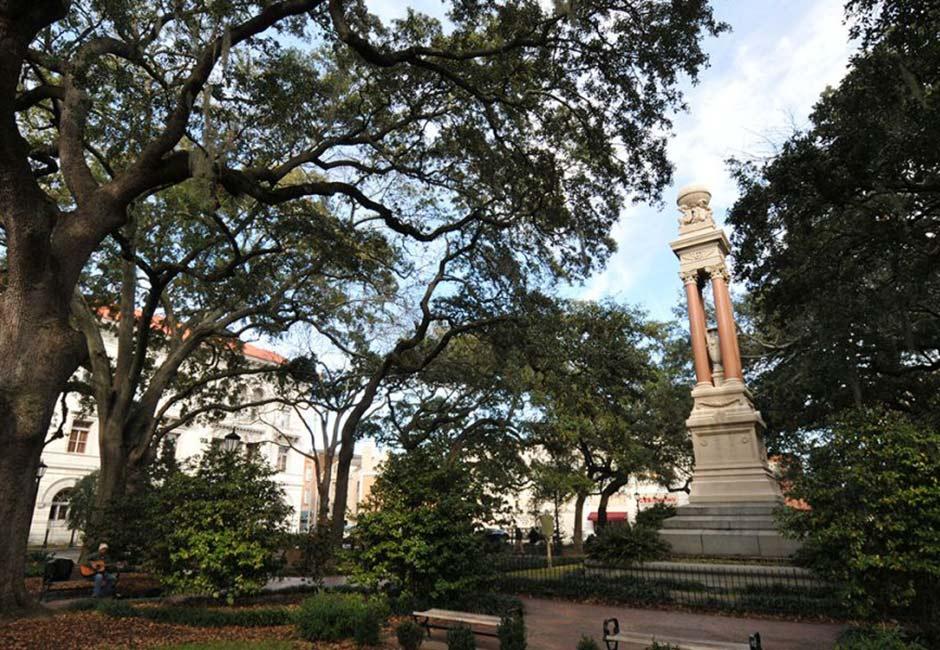
Arranged within the perpendicular streets of houses and buildings is a series of rectangular parks, each about two blocks apart. The squares give the downtown a more spacious, relaxed feel, causing traffic to move at a leisurely pace and providing a breath of fresh air amid the rush of the city. Today, each square is a unique and beautiful memorial to one of Savannah’s many historical figures and events, but they originally served a much more utilitarian purpose.
Founded in 1733 by General James Oglethorpe, Savannah was the first city established in the new colony of Georgia. Oglethorpe was a methodical man, and, true to his nature, he made sure that his city was well-planned before any construction began. Rather than the tightly-packed rows of houses familiar in England, Oglethorpe designed the city like a military camp — squares of open space, surrounded by houses. Savannah’s squares were intended to provide an open area for military exercises and town gatherings.
Additionally, the squares created spacing between buildings, which, the thought was, might prevent the devastating fires that had plagued London and other cities in the past. (This was only marginally successful, as Savannah suffered at least two catastrophic fires in 1820 and 1865.)
The original plan for the city called for a total of six squares. Johnson Square was the first to be constructed. Located between Bryan and Congress Streets and intersected by Bull Street, it is named after Robert Johnson, a friend of Oglethorpe’s and the governor of the Province of South Carolina in the early 1700s. In 1718, Governor Johnson, gained fame and popularity among the colonists by personally organizing a ship, to be led by Colonel William Rhett, a military hero, to find and eliminate the pirates plaguing the coast. Within weeks, Rhett captured Stede Bonnet, known as the “Gentleman Pirate” because of his semi-aristocratic upbringing. Bonnet had begun his crime spree barely a year before, when he abandoned his life as a wealthy planter and purchased a ship (an unusual departure from conventional piratical hijacking), hired a crew, and set off to create havoc. After a drawn-out battle, Rhett’s crew managed to take Bonnet’s ship and returned to Charleston with Bonnet and his crew in shackles. Despite his pleas for leniency, Bonnet was eventually hanged, leaving Governor Johnson with a public relations coup and more peaceful South Carolina.%GALLERY%The second square to be constructed was Wright Square, rechristened in 1763 to honor a royal governor of Georgia. Wright Square bears the distinction of containing the remains of Tomochichi, a chief of the local Creek tribe, who became a staunch ally of Oglethorpe and who aided the first settlers in Savannah. A granite boulder from Stone Mountain has replaced the pile of stones that at one time marked the grave of Tomochichi, but there is a more unusual memorial of the life of this great leader. A portrait of Tomochichi and his nephew, painted during their visit to London in 1734, preserves not only the likeness of a distinguished man but also a rare image of an early 18th century Native American.
Ellis Square, the third of the original four squares and also named for a royal governor, was constructed as the primary marketplace of the town of Savannah. In the 1950s, a brick market building that had occupied the square for a century was demolished, and a parking garage was erected in its place. The destruction of the Ellis Square market had a silver lining, though: it led to the start of the historic preservation movement in Savannah and ultimately the renovation and reopening of the square.
Telfair Square, Reynolds Square, and Oglethorpe Square round out the six squares called for by General Oglethorpe’s plan. During the rest of the 18th century, six new squares were constructed, and 12 more were completed by 1851. Today, the charming and verdant squares are not only links to the past, but collectively are a vision for the future: Savannah’s city planners still refer to Oglethorpe’s designs and continue to incorporate green spaces wherever possible.