Written by Palmetto Bluff
Sep 15, 2021
The Palmetto Bluff Conservancy began studying bats in 2015 and has established Palmetto Bluff as a long-term bat research and monitoring site. We attempt to net bats year-round and divide our netting effort into seasonal netting “sessions,” with each session having specific objectives. The summer 2021 session ended in late July and we had several exciting captures.
We have three major goals for summer netting. The first is to catch as many young-of-the-year bats as possible. These bats are just beginning to fly and are still a bit clumsy, rendering them less able to avoid our nets than adults. This makes it easier for us to catch a relatively large number of bats in a short period of time. Additionally, when we recapture bats banded when they were young-of-the-year, we know their exact age at recapture, which is something we do not know for bats banded as adults.
As in spring netting, a second goal of summer netting is to document the timing of reproductive activity and record anomalies. Females in July should have already given birth to their pups and either have fully weaned them or be close to it. It is unusual to catch females that are still pregnant at the end of July or August, and we keep track of the frequency of these instances.
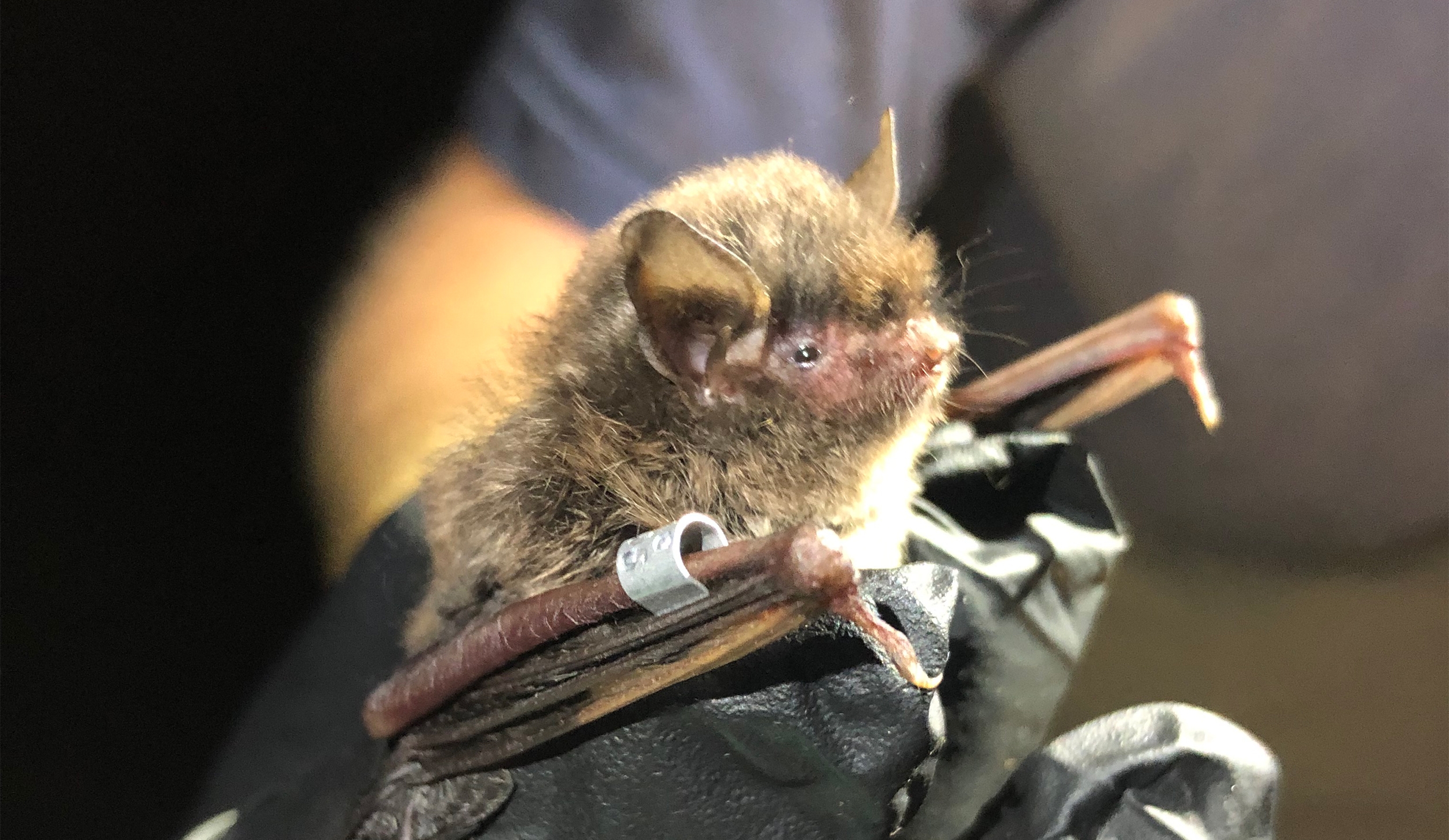
The third major goal of summer netting – and which is a goal year-round – is to catch northern long-eared bats. This federally listed species has experienced a 90% population decline throughout its range since 2006. Its existence on the coast of South Carolina was unknown until 2016, when two individuals were documented at Palmetto Bluff. This is the main species we are targeting when we erect our nets, and our nets are set in patterns that increase our chances of catching northern long-eareds. Unfortunately, their populations are at such low levels that they are extremely difficult to catch. Any documentation of this species at Palmetto Bluff is crucial for understanding conservation measures to take to help this once ubiquitous species.
Compared to our spring 2021 netting session, our summer 2021 session was half as long but equally productive. Our summer 2021 netting effort consisted of 12 nights from June 22 – July 30. We erected 2-8 nets per night, depending on the location and abundance of flyways. We captured 108 bats of 7 different species, including big brown, evening, tri-colored, Seminole, eastern red, southeastern myotis, and northern long-eared bats. We averaged capturing 9 bats per night in the summer, compared to an average of 4.5 for the spring. We tend to have a higher capture success rate (number of bats captured/ (number of nets erected each night x number of nights netted)) in July because of the newly volant (or newly flying) juvenile bats, which are not adept flyers and are naïve about nets. Our capture success for all July sessions from 2015 – 2021 is 6.69% compared to the overall average of 4.89%.

We had several exciting captures this summer, including two species we hardly ever see at Palmetto Bluff: eastern red bats and southeastern myotis. We caught 5 eastern red bats this summer, increasing the total number of red bats captured in 2021 to six. This species occupies a niche similar to the closely related Seminole bats, but we usually do not see many of them in this proximity to the coast. As you move inland, you catch fewer Seminoles and more eastern reds. Their brick red fur is a bright contrast to the muted mahogany of Seminoles. Like Seminoles, eastern red bats roost in the foliage of trees, hanging on to small branches and leaf petioles. Unlike many other species of bat in our area which have naked or partially furred tail membranes, eastern reds and Seminoles have fully furred tail membranes, which they wrap around themselves like a blanket when roosting. We captured two adult females and two juveniles at the entrance to the Longleaf Pine Loop trail on the same night.

The second species we hardly ever see is the southeastern myotis, of which we caught three this summer. This species likes bottomland hardwood forests, a type of forest that is not abundant at Palmetto Bluff. They are particularly fond of roosting in trees with large basal cavities, or cavities that are found at the base of a tree. Pictured here is the basal cavity that we tracked a male southeastern to in the fall of 2019.


As stated earlier, it is unusual to find pregnant bats in July. Most of the females we caught in late July showed signs of having nursed pups earlier in the year but were not currently pregnant. Having said that, we caught 5 pregnant big browns, 1 pregnant tri-colored, and 1 pregnant Seminole bat this July. We have documented several pregnant females in the fall over the last few years, so we expect to find some anomalous pregnancies in the late summer too. Even so, each out-of-season pregnancy is always a perplexing observation that leads to a larger discussion within the netting crew about bat reproduction.
In addition to new captures, we had two recaptures that are worth mentioning. The first is a male evening bat that was originally captured in 2018 in River Road Preserve. This is a site that is very productive thanks to a fantastic flyway that funnels bats into our nets. We net here multiple times each year. We have recaptured him three times this year: twice at that same site and once at a location within 0.5 miles from his initial capture. Two recaptures were in the spring and one was in the middle of July. Where he was in 2019 and 2020 when we did not catch him remains a mystery. We have not frequented this site as much this year as we have in previous years, so it is remarkable that he keeps ending up in our nets.
And last but certainly not least, we captured a male northern long-eared bat! While this is exciting in its own right, this is particularly thrilling because it is the third time we have captured this individual, and the second time we captured him at the same location.

Originally netted in River Road Preserve in 2018, Larry the northern long-eared was transmittered and tracked to a roost near the Longleaf Pine Loop Trail. The following year he was captured at the entrance of the Longleaf Pine Loop trail and tracked to a roost in the undeveloped portion of Palmetto Bluff. We had limited ability to net in 2020 due to the risk of the netting crew spreading SARS-CoV-2 to bats, and we did not catch Larry that year. This summer we caught Larry at the entrance to the Longleaf Pine Loop trail, tracked him to a roost near where he roosted in 2018, and then…he flew out of range of our telemetry receiver and we did not pick him up again. Hopefully we will net Larry next year and continue tracking his roosting whereabouts.

Overall, the summer 2021 session was enlightening. We tried sites where we have not netted in a few years, with great success. We had a fourth objective for our summer netting that I did not mention in this post. You will learn all about it in next month’s guest post, written by Sam Holst, Conservancy research fellow.
Want to learn more about Lydia’s important work studying bats at Palmetto Bluff? Explore the Dusk to Dawn series, covering everything from common myths and urban legends to threats facing our winged friends. Learn more.