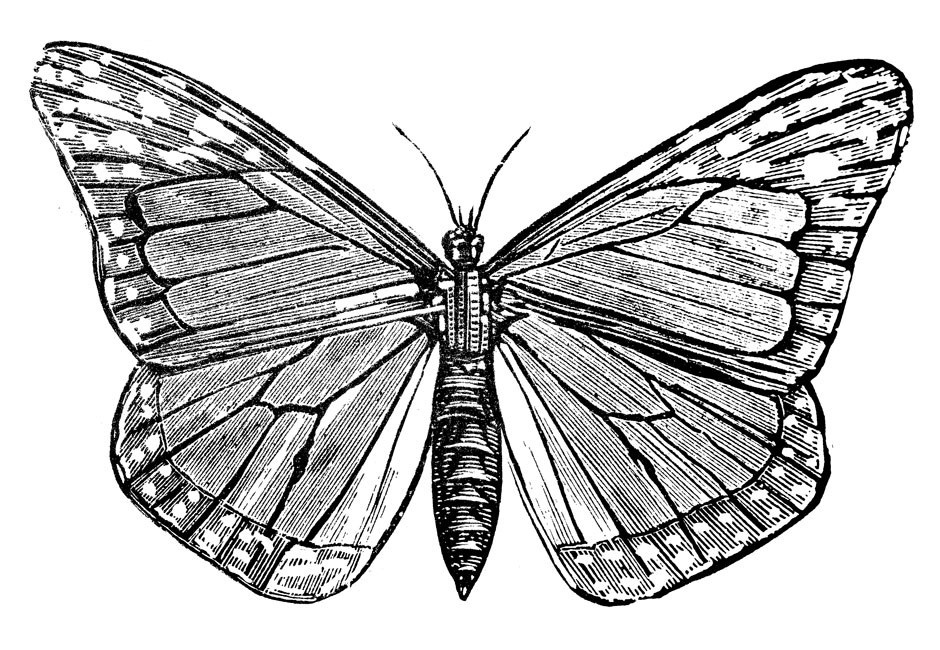
With its vibrant orange wings inked with black lines and edged with brilliant white spots, the monarch butterfly may be the most widely recognized species of butterfly in North America. It’s also commonly seen at Palmetto Bluff, where you might spot it flitting among petunias on the porches in Wilson Village, amid the geraniums in the gardens in the River Road neighborhood, or on the milkweed at the Moreland off ice of the Palmetto Bluff Conservancy.
The monarchs that you see, however, are not year-round residents; they are just stopping off at the Bluff for a few sips of nectar on their way south (in fall) or for a snack and to deposit a few eggs on their trip north (in spring).
The annual migration of monarch butterflies is one of the most remarkable in the animal kingdom. In September and October, as the days grow shorter and the temperatures start to fall, millions of monarchs begin a journey that may be as much as 3,000 miles, from Canada and the northern United States to Mexico or parts of southern California. They travel south and west for two to three months, often flying 50 to 100 miles in a single day, intent on reaching a winter haven where they will not be threatened by deadly frosts and snow. But a feast on succulent nectars from tropical blossoms in balmy climates is not in the plan. The monarchs are heading south to hibernate and live off their fat reserves, eating very little or not at all during their sojourn in the South. At a handful of sites in the mountains of Mexico and in coastal California, where the conditions are ideal (cool but not freezing temperatures and plenty of freshwater), thousands, and in some cases millions, of monarchs congregate to rest, covering the trees in fluttering cloaks as they await the arrival of spring, the signal to return north.
In late February, the exodus begins and the monarchs abandon their roosts to travel north and east, stopping and laying eggs when they reach the early blooms and young milkweed plants of the southern United States and eastern and northern California. These new monarch parents, who survived the autumn’s perilous journey and the winter’s fast, don’t live to see their offspring hatch, become fat caterpillars, and then metamorphose into winged beauties. The monarchs that overwintered die shortly after mating and depositing eggs in the spring. It is their children that continue the journey started by their parents, spending the two to six weeks of their lifespan traveling farther north and laying eggs for the next generation before they die. It will be the third generation that reaches its northern home and the fourth generation that will grow up there and then return to Mexico or California, where its great-great-grandparents spent the previous winter. Only this fourth and final generation of the year will live six to eight months (instead of two to six weeks), the time required to make the journey south, hibernate, and return to start a new brood of monarchs the following spring. Even more extraordinary than this multigenerational trek or the disparate lifespans of the generations is that the fourth generation, separated from the last population to migrate by three generations, will roost in the exact same trees their great-great-grandparents occupied a year previously. (Biologists are trying to identify the environmental cues and genetic codes for this incredible instinctual behavior.)
Sadly, the North American monarch population is declining rapidly due to loss of habitat, disease, and climate change. One problem is that although the adults don’t seem to discriminate in the flowers they take nectar from, milkweed is the only plant monarch larvae (caterpillars) can eat.
Milkweed plants are in the genus Asclepias, named after the Greek god of healing and medicine, Asklepios, an ironic name, as the plants contain toxins that are poisonous to most vertebrate animals, including humans. As the caterpillars feast on the milkweed plant, they ingest cardiac glycosides, a class of compounds that can affect the function of the heart. However, what may be a danger to us is a defense mechanism for monarchs. These toxins, dangerous and foul-tasting, are retained in the monarchs’ bodies throughout their lives, making not only the larvae, but also the adults noxious and potentially deadly prey. A predator that survives eating a monarch learns not to try consuming another.
Over the last few decades, urban development and the widespread use of herbicides have had a devastating impact of the amount of milkweed in North America. In the U.S. alone, the loss of monarch habitats since the early 1990s is estimated to be about 147 million acres (a staggering amount that is seven times larger than the state of South Carolina). On top of that, land-use practices such as farming with crops genetically modified to resist herbicides have severely affected the milkweed, a plant that thrives in disturbed areas such as the edges of fields. The herbicides kill plants, including milkweed, that grow around the cultivated areas but lack the crop’s genetic modifications that provide protection.
Although large-scale milkweed restoration efforts are underway around the country, individual efforts can make a big difference. If you would like to help monarchs but are hesitant about growing anything with the word “weed” in its name, don’t worry, milkweed is actually a wildflower and it is not classified as an invasive or undesirable weed. In fact, rather than fighting off the unwanted expansion of milkweed, the problem most gardeners have is getting the native milkweed, Asclepias tuberosa, to thrive in gardens of the Bluff (though it does very well along the roads and fields in the undeveloped sections). However, tropical milkweed, Asclepias curassavica, grows quite contentedly in the dry, sandy soil of coastal South Carolina and its scarlet and orange flowers are beacons to bees and butterflies. (The milkweed planted around the courtyard by the Conservancy’s offices at Moreland is the tropical variety and the plants hosted their first brood of monarch caterpillars this past May.)
Tropical milkweed survives mild winters in the South and provides an important source of food to increasing numbers of monarchs that are late migrants in the fall or early migrants in the spring.
Here at the Bluff, we can help the monarchs by adding milkweed to our gardens and it will only take one or two of these delicate creatures to glide by for you to understand how monarchs have gracefully sailed into the hearts of nature lovers of the entire continent.
%GALLERY%Side bars:
Adult Butterflies –
DANAUS PLEXIPPUS
To the untrained eye, most monarch butterflies look pretty similar. But if you take a closer look, you can see how different males and females are. This distinction can be an important one for anyone hoping to find monarch eggs in their gardens because, rest assured, the males will leave no such gift. Males are generally larger than the female butterflies but the easiest distinction between the two are the two black dots on the hind wings of the male butterflies that are not present on females.
Caterpillars –
MONARCH LARVAE
When monarchs lay their eggs on milkweed plants, it usually takes around four days for the eggs to hatch into little caterpillars. The caterpillars start out small with black and white stripes, but as they continue to feed and grow, they molt and shed their skin. As they do this, they retain their black and white stripes but also gain streaks of bright yellow. It only takes about two weeks for the caterpillars to become fully grown and by then they are anywhere from 25 to 50 millimeters in length.
Milkweed Distinction –
ASCLEPIAS CURASSAVICA
There are two types of milkweed growing here on Palmetto Bluff: tropical and native. Tropical milkweed (Asclepias curassavica) is what is planted at Moreland, but there is also native milkweed (Asclepias tuberosa) growing around the property. The most obvious difference between the two is the flower coloration. Tropical milkweed has bright orange and red flowers; whereas, the native milkweed is orange and has no red at all. Both are equally suitable for hosting monarchs; however, native milkweed is more difficult to transplant to different areas. Nevertheless, both plants’ seeds can be purchased and planted with ease.
By: Kellen McAuliffe
Photos by: Krisztian Lonyai