During any other event at Field + Fire, Palmetto Bluff’s grand celebration of sporting and tradition, a light driving rain would be nothing short of disaster.
But this event was different. Under cloudy skies and the constant prickling of invisible raindrops, the gently rolling hills of Longfield Stables took on the mystique of a storybook Yorkshire meadow. It was the perfect environment for an exhibition of a classically English sport, the foxhunt.
“In England, when cavalry officers were not fighting, they would hunt fox to keep themselves and their horses in shape,” said Nina Burke, head of Lowcountry Hunt, to the small crowd assembled under the tent. With all eyes on the horses galloping past beneath steely skies, Burke gave a master class in the grand traditions and the history of not only the sport, but also our own local hunting group.
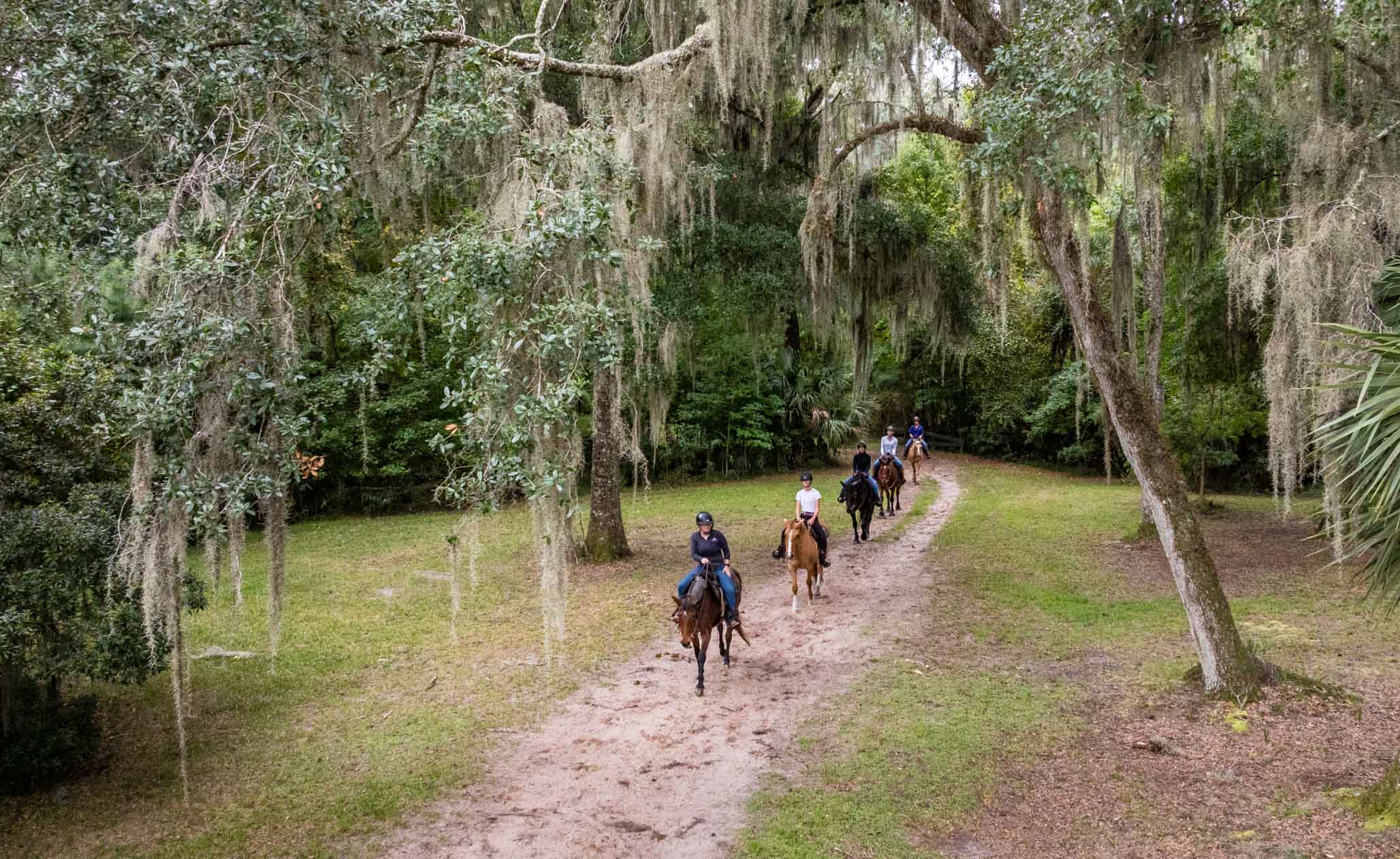
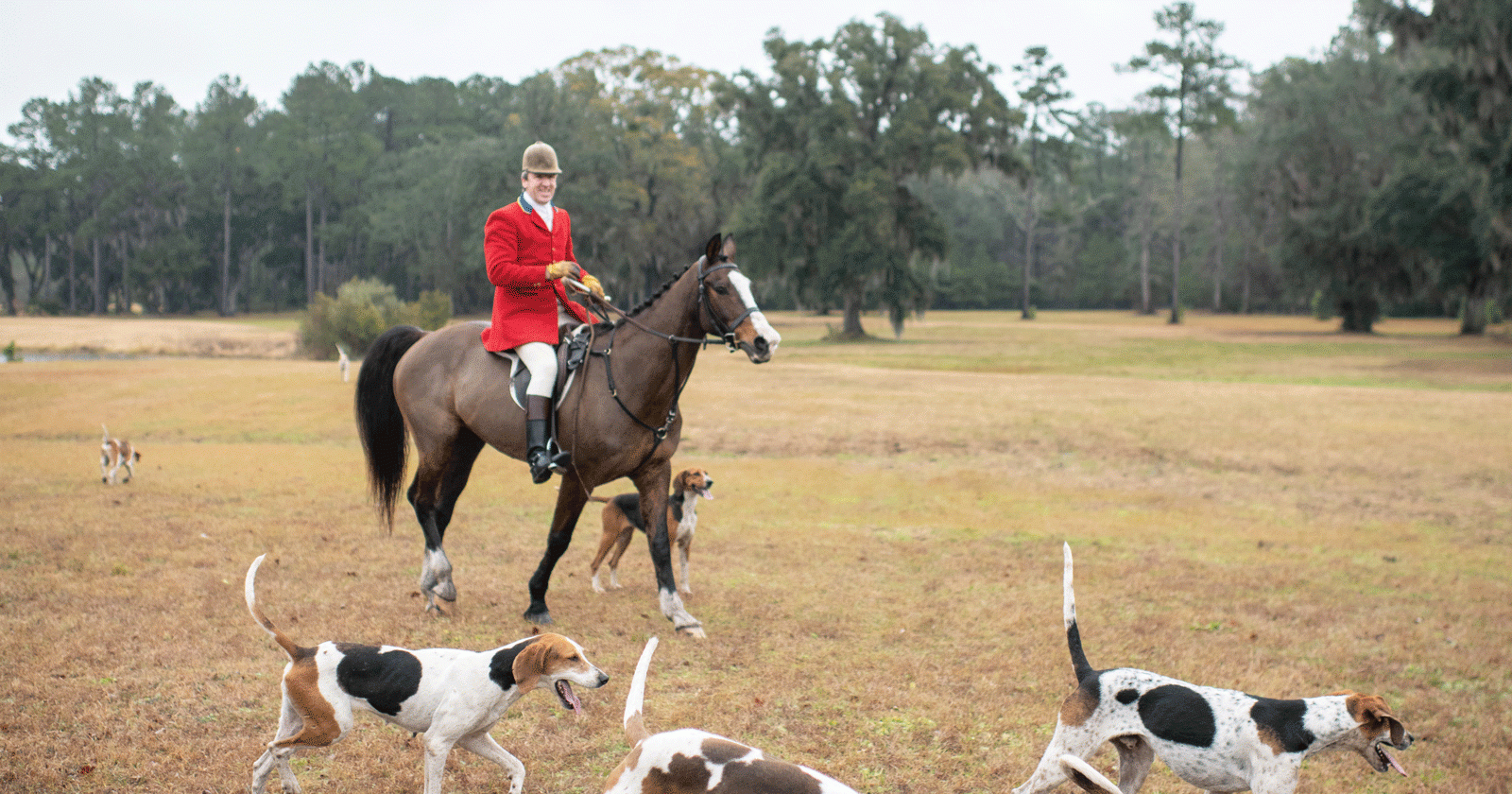
It began with a signal from huntsman Tony Gammell, assembling his pack of 25 American Foxhounds via a staccato blare from his horn. As he rode forth, Burke shared how the first pack of foxhounds in the country belonged to George Washington, a gift from Lafayette. Those bloodlines still run strong, coursing through the veins of every one of Gammell’s hounds. The hunt thundered past the tent, ducking in and out of the odd copse of trees, encircling the far fields of Longfield Stables, while Burke explained how the two “whippers-in” were keeping the hounds close to the huntsman and how each wave of riders contributed to the chase, from the swift first field to the hilltoppers of the third field.
More than an exhibition of a centuries-old pastime and the magnificent animals that make it possible, the day showed how Lowcountry Hunt was breathing new life into a sport defined by its traditions.
Lowcountry Hunt was established in 2006, but for Burke, the lure of foxhunting goes back much further than that. “I’ve been doing this since I was two years old,” she said in her sweet Walterboro drawl. Her father had been in the ROTC cavalry at the University of Georgia, “So by God, I was going to ride a horse.”
The grand traditions of Lowcountry Hunt echo the grand traditions of the sport itself. The organization’s masters and huntsman all wear ceremonial red coats, which oddly enough are called Pinck coats, named for the London tailor who invented them. Each hunt has its own colors represented on the collar, and the colors of Lowcountry Hunt were chosen to reflect South Carolina’s agricultural heritage: blue for indigo and gold for Carolina Gold rice.
But perhaps what makes Lowcountry Hunt special is how it breaks from tradition. For example, you’d imagine very few of the
18th-century hunts organized by English cavalry would have allowed for an eight-year-old girl to join them. But seeing young Sophia Mauldin galloping across the field astride her Welsh pony, Tinkerbell, you can imagine that she’d have run circles around them.
“She used to hunt in diapers, and I know this because I’ve been with her the whole time,” Burke said with a laugh.
Sophia and her mother, Shanna, are among the 90 members of Lowcountry Hunt, which organizes foxhunts up and down the ACE Basin region (that’s the area bounded by the Ashepoo, Combahee, and Edisto Rivers, for those in the know). Although the hunts are usually held on private plantations, the group visits Palmetto Bluff fairly regularly, putting the hounds and horses through their paces on the preserve’s rugged terrain.
“We won a national award for wildlife habitat conservation in 2009, so we always try to partner with people who are interested in doing that,” Burke said.
That preservation is key to Lowcountry Hunt’s philosophy and another way they part from tradition. To them, the thrill is in the chase.
“A red fox . . . loves the chase. They will lead the hounds through ponds, up across the top of a fence . . . they just kind of make it up as they go along. It’s a game. And when they finish, they’ll run back to their den,” Burke said. “In England, they’d send the terriers in and kill the fox. We don’t do that. When he goes to ground, we say, ‘Bye, we’ll see you another day.’”
That respect for nature made Tony Gammell a perfect fit as the new huntsman when he joined in April of 2018. More inclined to use a tennis ball launcher than a whip to keep his hounds’ attention (“That’s why these hounds love him,” Burke said. “They get treats and they get tennis balls.”), he’s that rare breed of huntsman who thrives on the pursuit, the traditions, and the chance to enjoy nature more than a simple trophy.
“I’ve never in my life shot a fox. I actually like them,” Gammell said. “They’ll beat us sometimes, and it’s like, ‘Good on you, man,’ and sometimes we beat them.”
In this case, beating them simply means chasing a red fox to ground or chasing a gray fox up a tree. And that’s to say nothing of the teeming wildlife beyond foxes that call the Lowcountry home. During their hunts, it’s not uncommon for the hounds to pick up the scent of the odd armadillo, bobcat, or even wild hog. “I hate hunting hogs, because they hunt back. They will kill your dogs; it’s a very scary thing,” Burke said. “But to see a foxhound chase an armadillo is
just hysterical.”
More and more, though, Lowcountry Hunt is turning its attention to one of the most disruptive members of the Lowcountry’s food chain: coyotes. “We end up running coyotes 80 to 90 percent of the time,” fieldmaster Lamy Buck said. “We just went up to Gray and ran two coyotes. We don’t want to kill them; we just want to run them. There are too few of them, and we want to come back and play another day.”
But it’s less about the prey than it is the spectacle of these grand hunts, organized for the sheer sport and pageantry of a bygone era. “A lot of people come out for the rides, a lot of them come out to see the beautiful plantations,” Gammell said, adding with a laugh, “but wherever we go, we just try to leave it better than how we found it.”
Find out more at thelowcountryhunt.com.
Photography by: Bonjwing Lee