Written by Palmetto Bluff
Oct 26, 2016
It would probably still be up there if I hadn’t climbed back into the hayloft to get the pocketknife to cut into the hay bales for the horses below. In the shadows and covered in dust and cobwebs, the bulging old burlap sack was practically invisible, but the beam of the flashlight caught it just right.
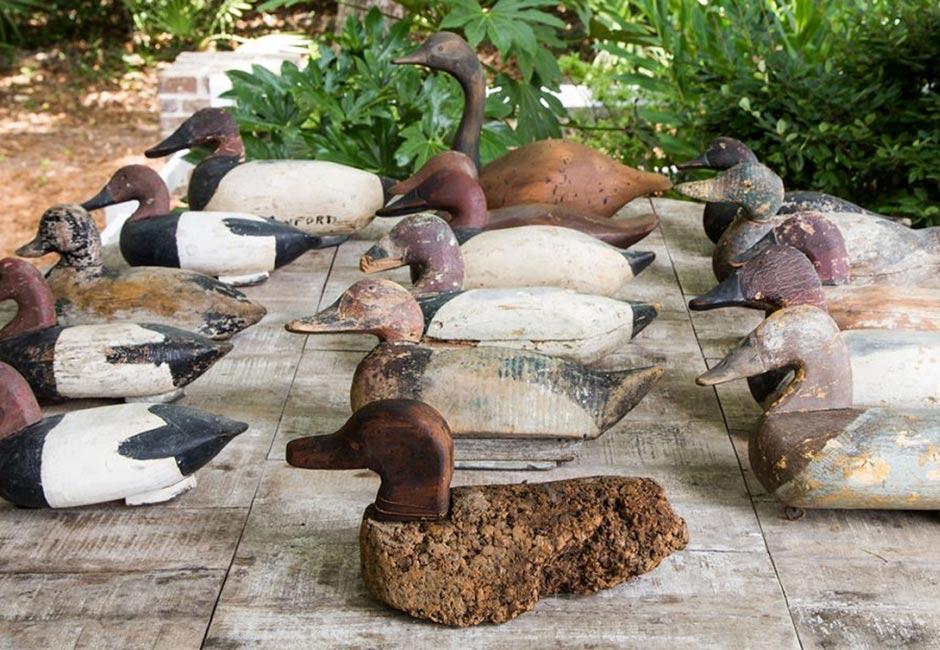
It was treasure that I’d found: a baker’s dozen of old wooden decoys, still rigged with rotted string and tied to the rusty nuts and bolts that my dad had used for weights. Even in the dim light I could see the hand-painted wings and eyes, the carved initials on the bellies of the birds, and the patina of their having been hauled around in a sack and tossed onto the floors of rowboats destined for 1940’s duck blinds.
They were spectacular. They were art.
And that is exactly what decoys are considered these days, one of the oldest forms of American Folk Art. Just watch an episode of PBS’s Antiques Road Show and you’ll see that the decoy experts are from the major auction houses’ American folk art departments. Former director of the American folk art department at Sotheby’s in New York, Nancy Druckman explains, “Decoys are interesting in that they are utilitarian objects and also works of art — a quintessential American art form, with pleasing sculptural qualities.”
Decoys have been made here in America since long before the pilgrims landed on Plymouth Rock. We know this because in 1924 a team of archeologists found 11 intact decoys stored inside two woven baskets in a cave in Humboldt County, Nev. The decoys were nearly 2,000 years old – the oldest decoys on earth.
Okay, so you might not find any of those in Grandpa’s back shed, but you might well find what I did: a remarkable, special, and maybe even a valuable collection.
From Cobwebs to Collections
Wooden decoys have become valuable because they have become increasingly scarce. In 1918 Congress passed the North American Wildlife Act and the North American Migratory Bird Act that significantly limited all hunting and completely banned commercial hunting for most migratory species. Like a light switch, the demand for decoys was all but switched off because the commercial hunters were the biggest customers for the decoy market. Fast forward to the 1950s and 60s when plastic molded decoys flooded the sportsman’s hunting market. These decoys were lighter, more easily transported, and even more lifelike! Sportsmen – like my father – were thrilled not to have to lug the old wooden blocks in burlap bags around any longer, and many old wooden “throw-away” decoys ended up being burned or tossed into the dump as worthless. It wasn’t until the ‘70s that these relics became recognized as the collectible folk art that they are regarded today.

That was when, in 1973, the auction of the collection of William J. Mackey, Jr. of Bedford, N.J., occurred. Still considered the most comprehensive national collection of American decoys, it was the auction that transformed the duck decoy market. Gary Guyette, president and founder of the preeminent decoy auction house Guyette and Deeter, explains: “In his meticulous research for his book, American Bird Decoys, 1965, author and collector, William J. Mackey, Jr. of Massachusetts, identified that there were ‘pockets’ around the U.S. of decoy collectors centered around sporting hotspots. Mackey studied and collected from each of these.”
Mackey organized his collection around six regions, each with its own style: the northeast; the mid-Atlantic down to South Carolina; Louisiana; the northern Great Lakes area; the Illinois River area south of Chicago; and the West Coast (from San Francisco up through the Columbia River area in Oregon). Mackey’s influence was profound. Appreciation for his collection gave structure to what had previously been a pretty random collector’s world. Guyette continues, “It was the first time that individual collectors from all over actually came together and recognized that there were other ‘pockets’ of [decoy] collectors out there. Folks that were used to getting what they wanted now were bidding against each other – and suddenly, for the first time, individual decoys pushed past the $10,000 point.” It was an eye opener for collectors – a “hey, we’re onto something!” moment, and a new collector subculture was born. Organization had helped set value, and after 1973 duck decoys began to behave in the marketplace more like commodities.
In the ensuing years collectors’ opinions evolved on the question of what makes decoys most valuable. Initially value was driven largely by the sensibilities of sportsmen, meaning that the most valuable decoys were the ones that were actually carved specifically for hunting – the ones that would best attract ducks. In fact, if the patina included a pockmark or two from actual shot, that was an additional endorsement, said the experts. This holds true in part today, as the market has diversified, for those collectors who value particularly “hunting patina.”
However, as in all collectibles, decoy collectors also value specimens that are in mint condition. So a great decoy can be one that was made for hunting but that never went to work, instead sitting in a box in an attic (or in my case, a barn). Or, as the market has evolved and carvers from the various regions became regarded more as artists than woodworkers, a great decoy at auction now is often one that was carved and rigged as a decoy, but the carver, beginning to appreciate decoys as the art we see them as today, actually carved it for display.%GALLERY%From Hunter Collectors to Connoisseurs
As tastes for collectable decoys have further matured during the 1980s – and a few decoys have brought eye-popping prices at auction – it became clear the market isn’t driven by sportsmen anymore. Dixon Merkt, an author and expert in decoy collectibles says, “Now the key players are art collectors whose standards are different than those of the original hunter buyers. The expectations are more nuanced and sophisticated with sculpture playing a larger and larger role.” Merkt explained that decoys carved with the bird “in action,” doing things such as preening, nesting, feeding, or resting (yes, that’s action), are those that are now most highly prized by collectors.

“The market is influenced by the demand of top collectors who might be looking for important additions to their collections, and are willing to pay accordingly,” he says. And the prices are staggering. “But that top tier of decoy buyers is very thin,” Merkt chuckles. “Gather them all together and they’d fit into a Volkswagen. And if it happened to go off a cliff, the market would dry up for a while!” So the number of folks that might have bid in the 2007 auction for the Lothrop Holmes red-breasted merganser hen that sold for the record $856,000 is pretty small.
Just like in the rest of the art world, big names bring big prices, too. Perhaps the most famous practitioner was Elmer Crowell (1862-1951), a masterful carver and painter who lived on Massachusetts’ Cape Cod. His decoys generally have carved wings and glass eyes, and he often used a rasp to imitate feathers on the back of his decoys’ heads and on their breasts. Crowell is largely considered the greatest of all the decoy carvers.
Other big names at auction are: The Ward Brothers, Captain Chauncey Wheeler, Harry V. Shrourds, The Mason Decoy Factory, Joseph W. Lincoln, Lothrop Holmes, and there are many more. Excellent examples of the work of well-known carvers can bring up to $50,000 to $250,000 at auction on a regular basis these days.
Merkt says that in our neck of the woods here in South Carolina is an excellent place to come across a wide variety of duck decoys. For nearly two centuries now, well-heeled sportsmen have traveled to local plantations and farms around here to enjoy our world-class upland and waterfowl hunting, and the company of like-minded sportsmen from around the globe. Some of the decoys they left behind, and more and more from elsewhere every year, can be seen at the Southeastern Wildlife Exhibition (SEWE) Decoy Auction that occurs every year in February in Charleston.

If you’re wondering what you have, you may want to reach out to Guyette, Schmidt & Deeter – in fact you might have already seen them as they manage the auction and decoy show at SEWE each year. Just snap a couple of photos of the decoy you want identified and email it to them. They’ll appraise it at no charge. In a surprising quick amount of time they’ll get you return to you what in real estate would be called “a windshield appraisal,” along with their advice as to how best to liquidate the carving, should that be your direction. For details go to: www.guyetteandschmidt.com/appraisals.html
Most antique decoys aren’t signed or dated. So mostly what you’ll hear from them, and other appraisers, is that the standard-looking wooden duck decoy from unknown hands that has seen some action ends up in the $25 to $1000 range. Ok, so there are those stories of sportsmen who bought one at a yard sale for $5 and flipped it for $500. But for most of us, like for me and the best of my dad’s baker’s dozen, the highest and best use for the decoys we find in the hayloft is on a mantel or bookshelf. It’s a little difficult to put a number on sentimental value, so I’ll just say mine are priceless. I get to think of my Dad, and just enjoy the lines. Because every decoy is art.
Photography By Krisztian Lonyai